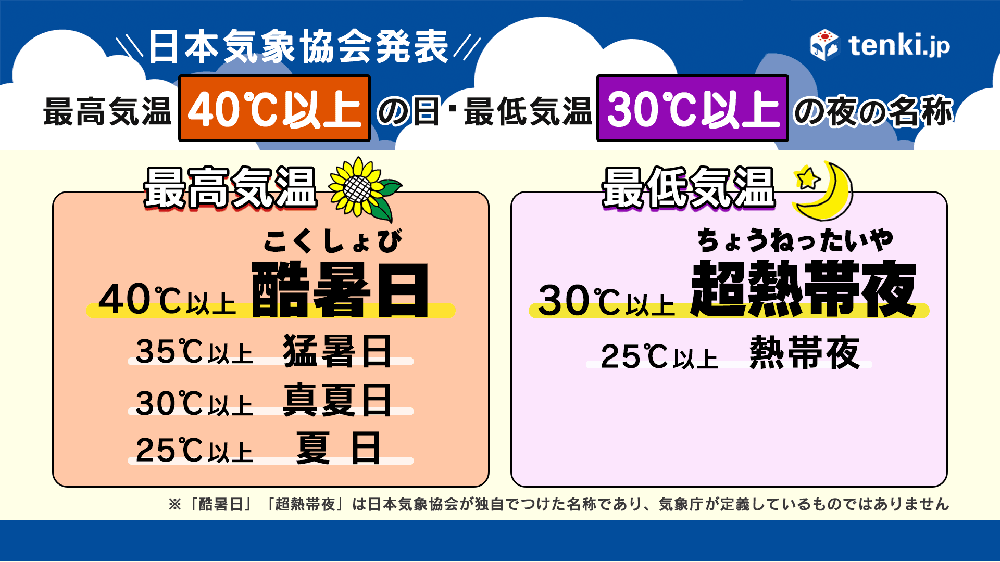
Days Over 40 Degrees Defined as "Kokushobi" (Extreme Heat Days)!
In April 2026, the JMA officially defined days with temperatures reaching 40°C or higher as "Kokushobi." The move prompts stronger measures against heatstroke.
On April 1, 2026, the Japan Meteorological Agency (JMA) announced that it will adopt the new term "Kokushobi (Extreme Heat Day)" to refer to days where the maximum temperature reaches 40 degrees Celsius or higher. Previously, days with a maximum temperature of 35 degrees or higher were defined as "Moshobi" (Extremely Hot Days). However, due to the frequent occurrence of record-breaking heat exceeding 40 degrees across Japan in recent years, the new category has been introduced to signal a higher level of alert.
The "40-Degree Barrier" Beyond Extremely Hot Days
Japan defined days with temperatures of 35 degrees or higher as "Moshobi" in 2007. Since then, temperatures have continued to rise, with Kumagaya City in Saitama Prefecture recording 41.1 degrees in 2018 and Hamamatsu City in Shizuoka Prefecture also hit 41.1 degrees in 2020. Instances of exceeding the 40-degree mark are becoming increasingly prominent.
In a press conference, a JMA representative emphasized the importance of the new definition, stating, "Heat exceeding 40 degrees poses a direct threat to human life. The term Moshobi alone is no longer sufficient to represent the current extreme weather conditions."
Temperature Classification Terms in Japan
Term | Definition (Maximum Temperature) |
Natsubi (Summer Day) | 25°C or higher |
Manatsubi (Midsummer Day) | 30°C or higher |
Moshobi (Extremely Hot Day) | 35°C or higher |
Kokushobi (Extreme Heat Day) | 40°C or higher |
Social Impact and Countermeasures
The introduction of the "Kokushobi" definition requires local governments and medical institutions to fundamentally review heatstroke prevention measures. In environments exceeding 40 degrees, more drastic behavioral shifts are needed, such as strictly cancelling outdoor activities and changing air conditioner usage from "recommended" to "mandatory."
Concerns also cover high-temperature damage to agricultural crops and increased strain on infrastructure due to surges in electricity demand. The government is considering implementing new warning alerts specifically for forecasted Kokushobi.
Sources