April 2026: A Giant Leap Toward Removing the 1.3 Million Yen Income Barrier
MHLW's package evolves in April 2026. A shift to base-pay criteria allows part-timers to maintain dependent status despite sudden overtime, boosting labor supply.
A Giant Leap Toward the Practical Removal of the 1.3 Million Yen Income Barrier in April 2026
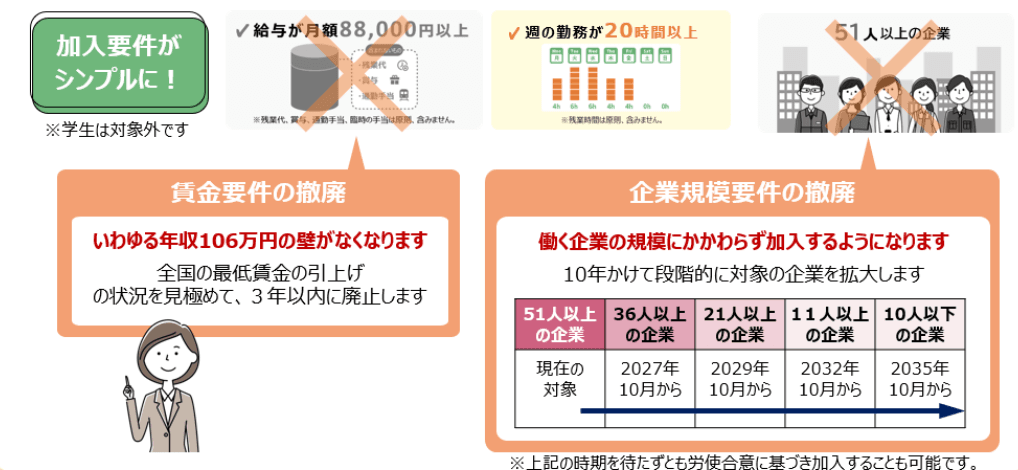
In April 2026, a dramatic shift took place regarding the long-standing "annual income barrier" issue that has distorted the Japanese labor market. The Ministry of Health, Labour and Welfare (MHLW) fully implemented the "Annual Income Barrier/Support Enhancement Package," evolving the assessment criteria of the "1.3 million yen barrier" to strongly support worker earnings and career progression.
Historically, many part-time workers engaged in "work curbs"—refraining from working extra hours even during peak seasons out of fear of losing their dependent status. This revision, however, significantly alleviates the psychological barrier and associated economic losses.
A Dramatic Shift in Assessment Criteria: Overtime Pay No Longer Breaks the Barrier
The biggest change since April 2026 is how income is assessed for social security dependent status. Previously, assessments were based on "expected income for the upcoming year," which included temporary overtime pay and allowances. This has now shifted to a base-pay system determined by the employment contract.
Consequently, even if temporary overtime earnings spike during peak seasons, workers will not lose their dependent status as long as their contracted base salary remains within the limit. This serves as a practical relief measure against the counterproductive phenomenon where working more hours resulted in lower take-home pay.
Long-term Benefits of Enrolling in Social Insurance
Overcoming the barrier and enrolling in social insurance yourself brings substantial benefits that improve long-term Quality of Life (QOL) far beyond immediate changes in take-home pay. In particular, the increase in future pension benefits serves as a powerful risk hedge for retirement.
Comparison Item | Dependent Status (Category 3 Insured) | Social Insurance Enrolled (Category 2 Insured) |
Future Pension | Basic Pension only | Basic + Employees' Pension (Permanently increased) |
Medical Benefits | None (Dependent under family health plan) | Injury and Sickness / Maternity Allowance eligible |
Take-home Pay | No insurance premium burden (Up to 1.3 million) | Premium payments required (Invested in future security) |
Multidimensional Perspective: A Win-Win for Workers, Businesses, and Society
This legislative change extends beyond simply easing the barrier, delivering broad social impacts.
For workers, it ensures career continuity. No longer constrained by dependent limits, they can take on more responsibilities and work longer hours, leading to skill development and income growth.
For businesses, it helps mitigate severe labor shortages. Previously, part-time employees frequently reduced shifts late in the year to avoid the barrier. Relaxing these limits stabilizes operations. Additionally, the MHLW's "employer certification" system, which allows dependents to maintain their status for up to two years under special circumstances, aids businesses with shift management.
For society as a whole, it strengthens the sustainability of the social security system. Increasing the number of contributors solidifies the system's foundation, maintaining the safety net in an aging society with a declining birthrate.
Broader Options for Working, But There Is More to Consider
The transformation of the 1.3 million yen barrier starting in April 2026 marks a turning point from constraint to choice in Japanese employment. While social insurance premiums are required, the resulting long-term security and career flexibility provide invaluable benefits.
Rather than freezing out of fear of the barrier, workers can choose to work flexibly according to their lifestyle. The new path laid out by the MHLW serves as a bridge to a richer future for all workers.
However, Kuroto feels that while easing constraints and removing the monthly stress of exceeding limits is a step forward, we need to re-examine why the dependent system was created in the first place. The essence of the system lay in child-rearing. Amid the financial burdens of children and the decline of extended family support in nuclear households, the freedom to work is important, but a comprehensive reform addressing child-rearing constraints is crucial for the country's long-term future.
【Reference Sources】
Annual Income Barrier / Support Enhancement Package - MHLW
Social Insurance Expansion Special Site - MHLW
Commencement of New Operations Regarding the Annual Income Barrier - MHLW