Hakata Dontaku 2026 Opens! 800 Years of History and Enthusiasm
The Hakata Dontaku Port Festival opened today, May 3, 2026, in Fukuoka. A thorough report on its 800-year history, shamoji spoons, and flower cars.
The Streets of Hakata in Enthusiasm! "Hakata Dontaku Port Festival" Opens
Today, May 3, 2026, the Hakata Dontaku Port Festival, an early-summer staple of Fukuoka, kicked off in the sunny streets of Hakata. For two days starting today, the entire city will be painted in festival colors, filled with "Dontaku-tai" groups in colorful costumes and sparkling "Flower Cars." With over 2 million visitors annually, this is one of Japan's largest festivals during Golden Week. Here we provide a comprehensive report covering its deep history, this year's highlights, and the passion of the Hakata locals.
Origins of "Dontaku" and Over 840 Years of History
The unique word "Dontaku" has its roots in the Dutch word "Zondag", meaning "Sunday" or "holiday." During the Edo period, this word came via Dejima and spread with the custom of celebrating holidays, eventually becoming the name of the festival. However, its core spirit dates back much further.
The festival's roots go back to 1179 in the late Heian period. It originated as "Hakata Matsubayashi," a new year's greeting started by Hakata's wealthy merchants to honor Taira no Shigemori, who built Japan's first artificial port, "Sode no Minato." During the reconstruction of Hakata after the civil wars of the Muromachi and Sengoku periods, this Matsubayashi served as a source of strength for the citizens. In the Edo period, "Torimon" processions were added as a courtesy to the Kuroda family, lords of the Fukuoka domain, adding to the splendor. Although temporarily banned by authorities in the Meiji period for being "too luxurious," the festival-loving heart of Hakata did not break, and it was revived under the name "Dontaku." In 1962, it was reorganized as the "Fukuoka Citizens' Festival," establishing the current style where anyone can participate while preserving tradition.
The Whole City is a Giant Stage! Spectacular Parades and Stages
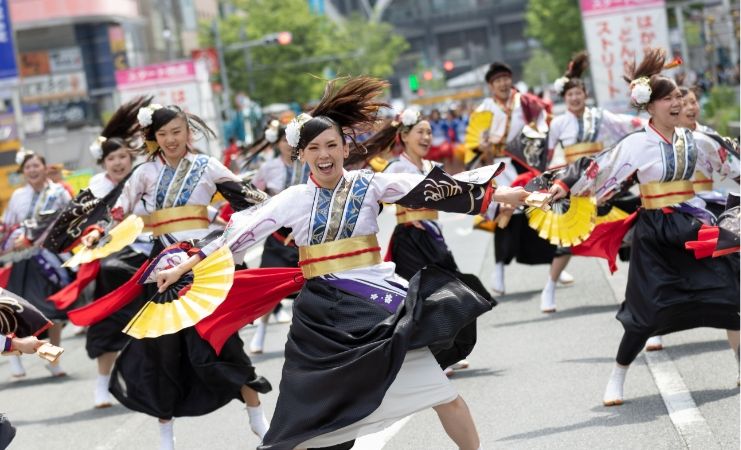
The greatest highlight of Dontaku is the parade on "Dontaku Hiroba" along Meiji Street (between Gofukumachi and Town). Spanning about 1.3 kilometers, this main street is filled with Dontaku-tai groups marching in unique costumes. Leading the parade is the "Hakata Matsubayashi," designated as a national important intangible folk cultural property. The three deities (Fukujin, Ebisu, and Daikoku) on horses and children in brilliant costumes marching to traditional music invite spectators back to the Heian period.
Following them are diverse groups including marching bands, local shopping streets, companies, and international organizations. Each group displays creative choreography and proud costumes, drawing loud cheers from the spectators. Additionally, the "stages" set up in about 30 locations across the city are must-sees. From large-scale stages at Hakata Station, the City Hall, and the Port Main Stage to small platforms in shopping arcades, dance, music, and traditional arts are performed everywhere. The entire city truly transforms into a massive entertainment space for two days.
Below is a summary of recent events and the 2026 trends.
Year | Estimated Visitors | Topics |
2024 | Approx. 2.35 million | Full return of spectator stands; record turnout with sunny weather for both days |
2025 | Approx. 2.10 million | Utilization of new redevelopment areas and expansion to LaLaport, etc. |
2026 (Est.) | Approx. 2.20 million | Introduction of AR viewing apps and eco-friendly Flower Cars |
"Shamoji" and "Rain": Hakata's Humor and Jinx
The "shamoji" (wooden rice paddles) held by Dontaku participants are said to have originated when merchants' wives, busy preparing dinner, couldn't resist joining the parade upon hearing the cheerful music from the street, grabbing the rice paddles they were holding and clapping them together. Today, the clattering sound of shamoji has become synonymous with Dontaku. Spectators also play along with their own shamoji, uniting with the performers. This casual "everyday life" touch is perhaps what makes Dontaku a true citizens' festival.
Also, one cannot talk about Dontaku without mentioning the "rain jinx." Statistically, rain is common during Dontaku, and locals laugh it off, saying, "Good weather is great, but rain is also part of the Dontaku experience." Fortunately, today in 2026 started with a pleasant breeze and thin clouds—perfect festival weather.
Art of Light: "Flower Cars" and Night Festivities
The splendor of Dontaku is symbolized by the "Nishitetsu Flower Cars" operated by Nishi-Nippon Railroad. Previously popular as "Flower Trams" on streetcar tracks, they are now large trucks decorated with LEDs and vibrant artificial flowers. The designs featuring popular anime characters and topical themes are loved by adults and children alike. When lit up in the evening, they turn into floating, glowing objects of fantasy, boosting Hakata's night scene. This year, under the theme "Leap to the Future," vehicles utilizing cutting-edge lighting technology have made an appearance.
Finale with "Soodori": The Moment Anyone Can Be a Lead
The festival's climax is the "Soodori" grand dance on the evening of May 4 at Dontaku Hiroba. Thousands of Dontaku-tai and spectators dance together to the melody of "Bonchi Kawaiya." This time, where spontaneous participation is welcome, represents Dontaku's spirit of "coexistence" and "harmony" best. Spectators eventually join the dancing circle, and strangers step together with smiles. Hakata's two passionate days close with the moving scene of the entire city becoming one.
Conclusion: Linking Tradition and Celebrating the Future
Modern Hakata is undergoing redevelopment and is lined with modern buildings. However, no matter how the town changes, the excitement of Dontaku and the spirit of the people supporting it remain the same. This festival, linked through difficulties for 840 years, is Hakata's identity itself. Why not feel the warm breath of Hakata in person or enjoy the excitement to your heart's content?
【References】
- Hakata Dontaku Port Festival Official Website
- Crossroad Fukuoka: Hakata Dontaku Port Festival
- Fukuoka Now: Hakata Dontaku Guide