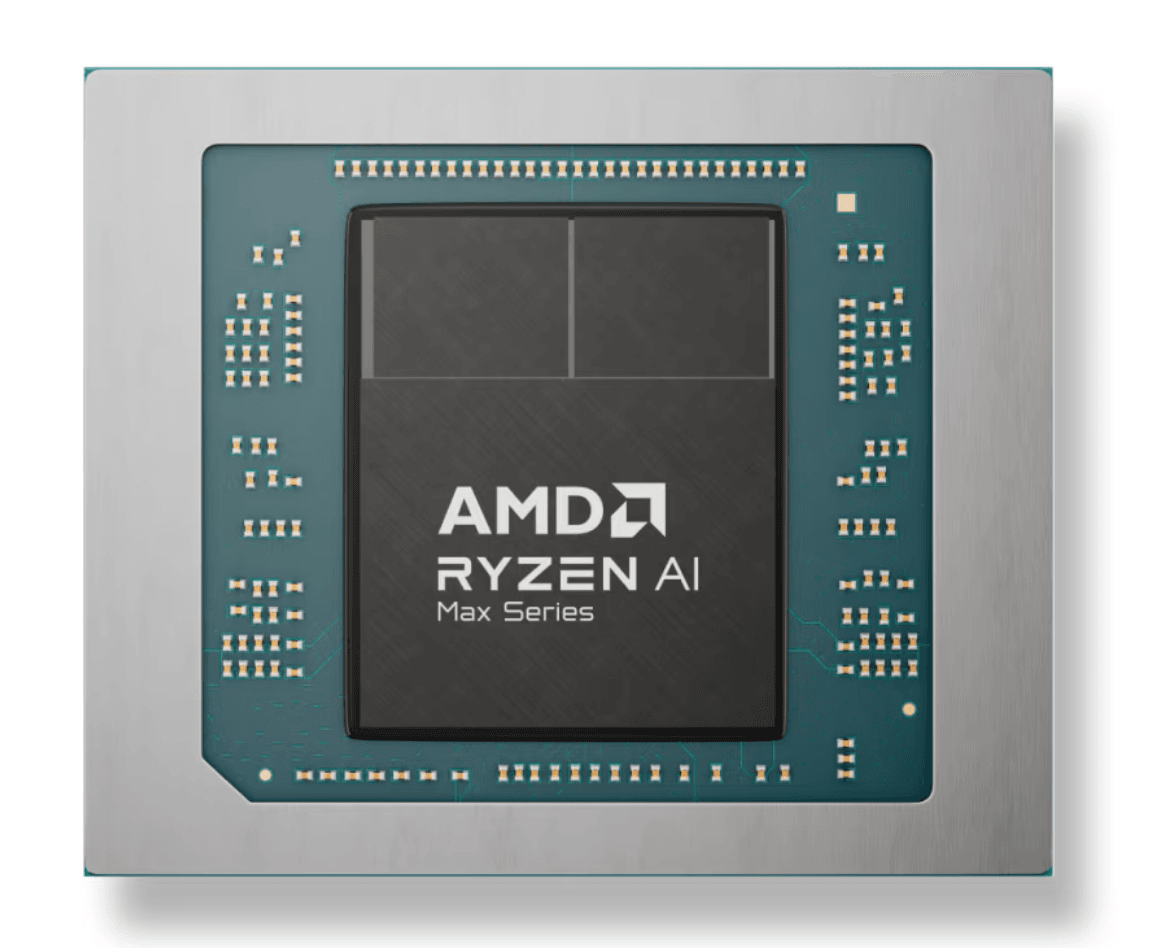
How AMD Ryzen AI Max+ 395 "Strix Halo" Redefines the AI PC Landscape
Analyzing the performance and cost efficiency of x86's sole integrated chip monster, compared to NVIDIA DGX Spark and Apple M5 Ultra.
Will this put an end to the era of NVIDIA's monopoly? However, if memory remains expensive, there might not be much benefit to the general public yet lol.
The Truth Behind "Strix Halo" Breaking the Limits of x86
In 2026, the biggest topic in the PC hardware community is no longer the number of CPU cores, but rather how efficiently AI and graphics computing resources can be integrated into a single chip. At the center of this conversation is AMD's next-generation high-end APU, the Ryzen AI Max+ 395 (codename: Strix Halo).
This processor completely overturns the conventional wisdom that "integrated graphics (iGPU) are only auxiliary." It features 16 Zen 5 cores along with 40 RDNA 3.5 computing units (CUs). Its graphics performance rivals that of NVIDIA's mid-to-high-end mobile GPU, the RTX 4070 Laptop, establishing itself as the "strongest integrated chip" in the x86 ecosystem.
The "Forbidden Fruit" of a 256-bit Memory Bus
The main reason APUs could not compete with discrete GPUs (dGPUs) in the past was a lack of memory bandwidth. While typical mainstream CPUs feature a 128-bit memory bus, the Ryzen AI Max+ 395 doubles this to 256-bit. In combination with LPDDR5X-8000 memory, it achieves a maximum bandwidth of 500 GB/s, matching former high-end graphics cards. By allowing the CPU and GPU to share the same ultra-fast memory pool, this configuration operates close to "unified memory," drastically reducing data transfer latency, particularly during large language model (LLM) inference.
Rival Comparison: The 2026 High-End Showdown
To clarify the position of the Ryzen AI Max+ 395 in the market, we compare it to Apple's latest monster machine, the "M5 Ultra" (referred to as Pro Studio Ultra in some materials), and NVIDIA's "DGX Spark" aimed at AI researchers.
Feature | AMD Ryzen AI Max+ 395 | Apple Pro Studio Ultra | NVIDIA DGX Spark |
Architecture | x86 (Zen 5) | ARM (Fusion) | ARM (Grace-Blackwell) |
AI Performance | 126 TOPS (System) | approx. 100 TOPS (Neural) | 1000 TOPS (FP4) |
Est. Price Range | From approx. $1,999 (System) | From approx. $5,999 | approx. $4,699 |
Yes, it's cheap! That's typical AMD. I have high expectations. Of course, some products are already commercialized, but while it is highly cost-effective, the reality is that the AI industry has been using NVIDIA's ecosystem for so long that software compatibility is still catching up.
The Apple Pro Studio Ultra dominates in running massive models exceeding 200B parameters with its overwhelming memory capacity of up to 256GB. Meanwhile, the NVIDIA DGX Spark is an "AI-specialized" machine focused on training small-to-medium models and ultra-fast inference leveraging the FP4 precision of the Blackwell architecture. In contrast, AMD's Strix Halo embodies the "democratization of AI PCs" by maintaining complete compatibility with the Windows ecosystem while keeping the system price at less than half.
SFF Adoption and the Impact of Cost Performance
The true value of Strix Halo is realized in "ultra-small AI PCs" and "next-generation gaming UMPCs" developed by manufacturers like Minisforum and GPD.
Previously, professional-level video editing and AI development required massive cases and expensive external GPUs. However, a 1-liter mini PC equipped with the Ryzen AI Max+ 395 shatters this concept. By eliminating external GPU chips and dedicated VRAM, it saves board area and simplifies thermal design, achieving unprecedented performance-per-watt.
Conclusion: Toward the "New Standard" of the AI Era
The AMD Ryzen AI Max+ 395 merges the versatility of x86 with the efficiency of an SoC (System on Chip) at an extremely high level. The introduction of the 256-bit memory bus marks a historic turning point, ending the era when APUs were considered only for cheap PCs.
【Sources】
- AMD Ryzen AI Processors Technology and Roadmap
- NVIDIA DGX Systems and Blackwell Architecture Overview
- Apple Mac Studio and M-series Ultra Specifications