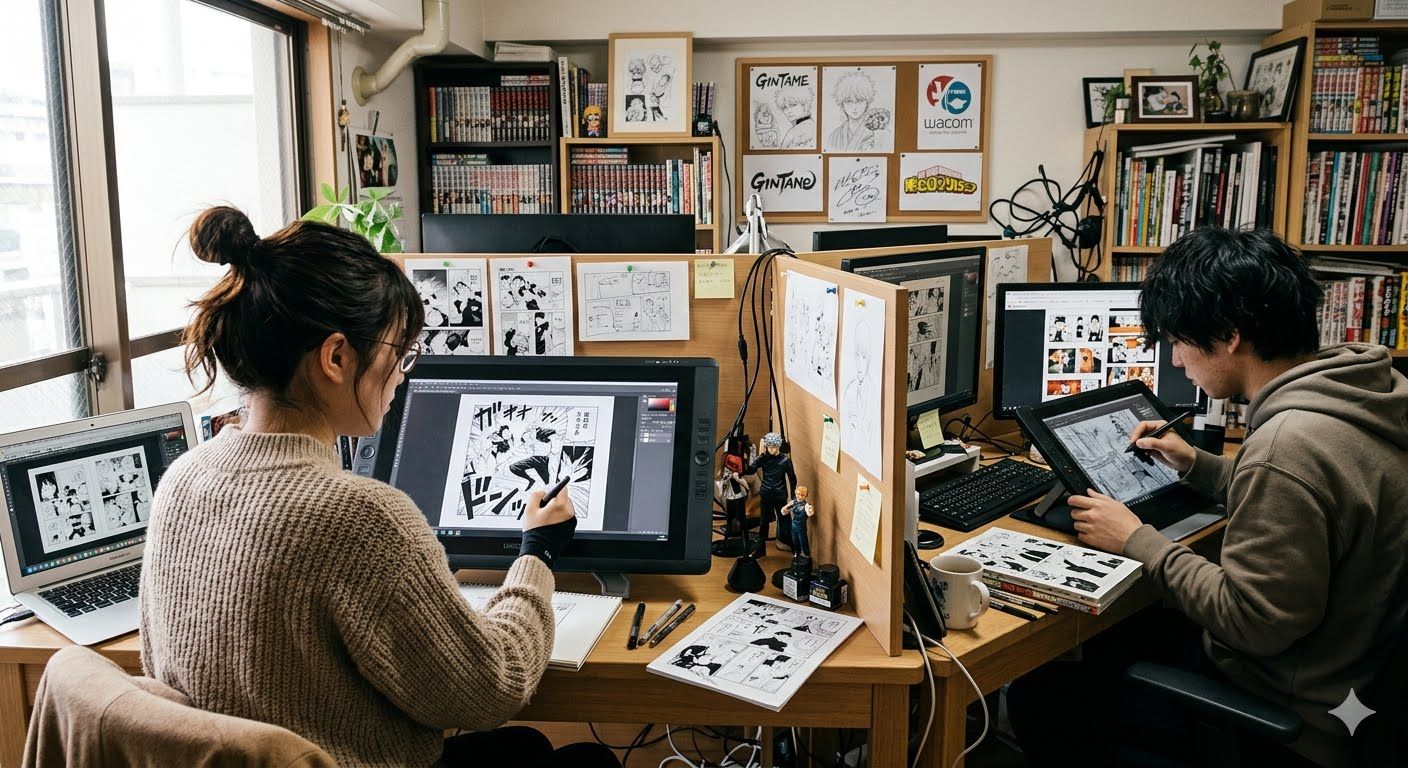
The Ideals and Realities of AI Manga Production: The New Burden of AI Direction
While AI manga has become technically feasible in 2026, creators face new challenges in directing AI models. The subtle nuances of human emotion remain a high barrier for AI tools.
In 2026, while image-generation AI has reached professional standards for standalone illustrations, the barrier to creating manga—a medium of sequential expression—remains high. A deep gulf exists between using it as a convenient tool and achieving true automation. Current AI manga production has simply swapped the physical labor of drawing for the cognitive load of directing and controlling the AI. It is still far from the one-click solution general users imagine. This article provides a critical analysis of the current state of AI manga and the massive amount of human intervention required behind the scenes.
Is Directing Harder Than Drawing?
In the 2026 AI manga production scene, the creator's role has shifted from "craftsman (artist)" to "director." However, this shift is by no means easy. Getting the AI to draw exactly what you intend requires a heavy workload known as **prompt direction**.
The Technology is Evolving, But...
Anyone who has generated images with AI knows that these models synthesize images by morphing learned data based on prompts. If there is no image matching the instruction, the AI does its best with similar data. Creators must engage in a tedious trial-and-error loop to get the right output. Those who can draw often find themselves thinking, "It would be faster to just draw this myself!"
Of course, there is a technology called LoRA (Low-Rank Adaptation), which allows creators to train the AI on 15 to 30 images of a specific character to learn details like hairstyle, eye shape, and clothing patterns. However, LoRA training is highly time-consuming. Preparing 30 images and training the model takes so long that by the time you finish, the chapter featuring that character might already be over, resulting in a self-defeating process.
To solve this, IP-Adapter is used to match characters based on a single reference image. However, because the sample data is so limited, it only works under very specific conditions.
The biggest issue is that none of these methods guarantee 100% success—they only reduce the randomness. Even after heavy prompt direction, there is always a chance the AI cannot produce the image, rendering your time and effort wasted. Ultimately, **substantial manual editing is required**, and poor implementation of AI can actually increase production time and stress.
The High Wall of Emotional and Contextual Nuance
While an AI can draw 100 variations of a surprised face, it cannot autonomously depict a face that is "pretending to look surprised while hiding deep sadness." Interpreting emotional context and subtext—the heart of manga—remains a highly advanced area that only humans can navigate. Consequently, an image generated through hours of prompt tweaking might show an expression that completely matches the scene, or feature a character that looks like a stranger if the learning dataset lacked matching poses.
Furthermore, it is currently impossible for AI to selectively deform or stylize characters to create impactful, memorable scenes. There is potential for very simple layouts with uniform panels where the story is driven purely by dialogue, or 4-panel newspapers explaining current events. Yet, even for these, fully automating the process is incredibly difficult due to the extensive prompt adjustments and subsequent manual edits that resemble redrawing.
Process | AI Capabilities & Limitations (as of 2026) |
Character Consistency | Technically solved to some extent (roughly 80% success, meaning 20% fail repeatedly), but implementation requires LoRA training and advanced environments. It is not a one-click process. The time spent drawing images for training could be used to draw multiple chapters, making it inefficient for characters with little screen time. |
Storyboarding & Panels | AI cannot comprehend flow or visual guidance. While template layouts based on patterns are possible, intentional deviations like characters breaking out of panels or custom panel shapes are not supported. |
Subtle Expressions & Acting | While basic emotions can be generated, AI cannot capture specific expressions suited to a scene, meaningful looks in a character's eyes, or unique poses essential to the narrative. |
A Division of Labor Deferring to AI's Strengths
Ultimately, the conclusion mirrors other content creation fields: a cooperative relationship is needed where humans and AI complement each other. However, AI is already causing a disruptive shift in the manga industry. A significant **divide** is emerging in production speed and quality between creators who can effectively direct AI and those who cannot.
Expanding Creative Inequality via Information Asymmetry
Currently, AI manga production is **polarizing the industry** between a select group of creators with the engineering skills to direct AI and everyone else. For general users, AI manga often ends up as a slide show of pretty pictures. Elevating it to a commercial standard requires the professional perseverance to handle extensive manual revisions (rework tax). Conversely, having the AI generate complex backgrounds and convert them into a manga style is **where AI truly shines**. Backgrounds are notoriously time-consuming to draw. What used to be handled by assistants can now be offloaded to AI. PC tools have long helped reduce work for speed lines and sound effects, and AI has made these processes even faster. Creators are no longer forced to sacrifice sleep just because they lack a team of assistants.
Conclusion: AI is a High-Performance Tool, Not Magic
In conclusion, while AI manga is now possible, **it is not a magical shortcut that turns anyone into a manga artist**. Instead, the ideal approach is to direct this temperamental AI partner to increase efficiency, freeing up time to focus on core creative tasks. Paradoxically, as AI becomes more common, the value of intentional human directing and hands-on manual corrections will likely grow higher than ever.
【Sources】
- MANGA NOW - Reality and Challenges of AI Manga Production
- The Television - Impact and Criticism of AI Manga Serialization
- Business Insider - Creative Labor Shift in 2026