Today is Mother's Day. On Daily Gratitude and International Women's Day
Today is Mother's Day. A 5-minute explanation of the deep history behind giving carnations, Ann Jarvis's peace movement, and the connection with International Women's Day.
May 10, 2026—"Mother's Day" is here again. While established as the second Sunday in May in Japan, we unravel its background from multiple perspectives: its origins, its deep connection with carnations, and its surprisingly little-known historical link to "International Women's Day."
Origins of Mother's Day: Two Women's Wish for Peace
Two 19th-century American women shaped the modern Mother's Day. One was Ann Jarvis. During the Civil War, she formed "Mothers' Day Work Clubs" to improve sanitation and helped wounded soldiers regardless of their side. Post-war, she organized "Mothers' Friendship Day" to advocate for peace and reconciliation.
The other was Julia Ward Howe, known for writing the "Battle Hymn of the Republic." In 1870, she issued a "Mother's Day Proclamation," calling on women to unite to prevent the tragedy of losing husbands and sons to war. Initially, Mother's Day was more of a social movement for peace than a simple day of gratitude.
Carnations and Anna Jarvis
It was Ann's daughter, Anna Jarvis, who popularized it as a "day to express gratitude to mothers." On May 10, 1908, she held a memorial for her late mother at a church and distributed her mother's favorite white carnations. This is considered the beginning of "Mother's Day."
Later, in 1914, President Wilson officially designated the second Sunday in May as a national holiday. Over time, the custom settled into giving red carnations to living mothers and white carnations to those who have passed.
Mother's Day varies slightly by country, but Japan follows the American rule (the second Sunday in May).
The Surprising Connection with International Women's Day
March 8th, "International Women's Day," and "Mother's Day" are historically intertwined at their roots. Both evolved from early 20th-century women's suffrage movements and anti-war activism by women.
Event Name | Main Focus | Historical Background |
International Women's Day | Women's rights & political liberation | Socialist movements & suffrage demands |
Mother's Day | Gratitude for motherhood & family bonds | Peace movements & mourning for mothers |
Interestingly, in some Eastern European countries, International Women's Day also serves as Mother's Day, where it's customary to give flowers to mothers on March 8th. Both share a core value of "respecting the women and mothers who support society."
Hoping for Wider Recognition of International Women's Day in Japan
Mother's Day has a strong image of gratitude towards great mothers, mainly from children to their moms. However, even if not mothers, women are always a great presence for men. Some religions have myths about men being born from a part of women, and while that metaphor seems fitting, International Women's Day on March 8th is inexplicably not yet widespread in Japan. I hope it becomes popular here soon.
The Language of Flowers
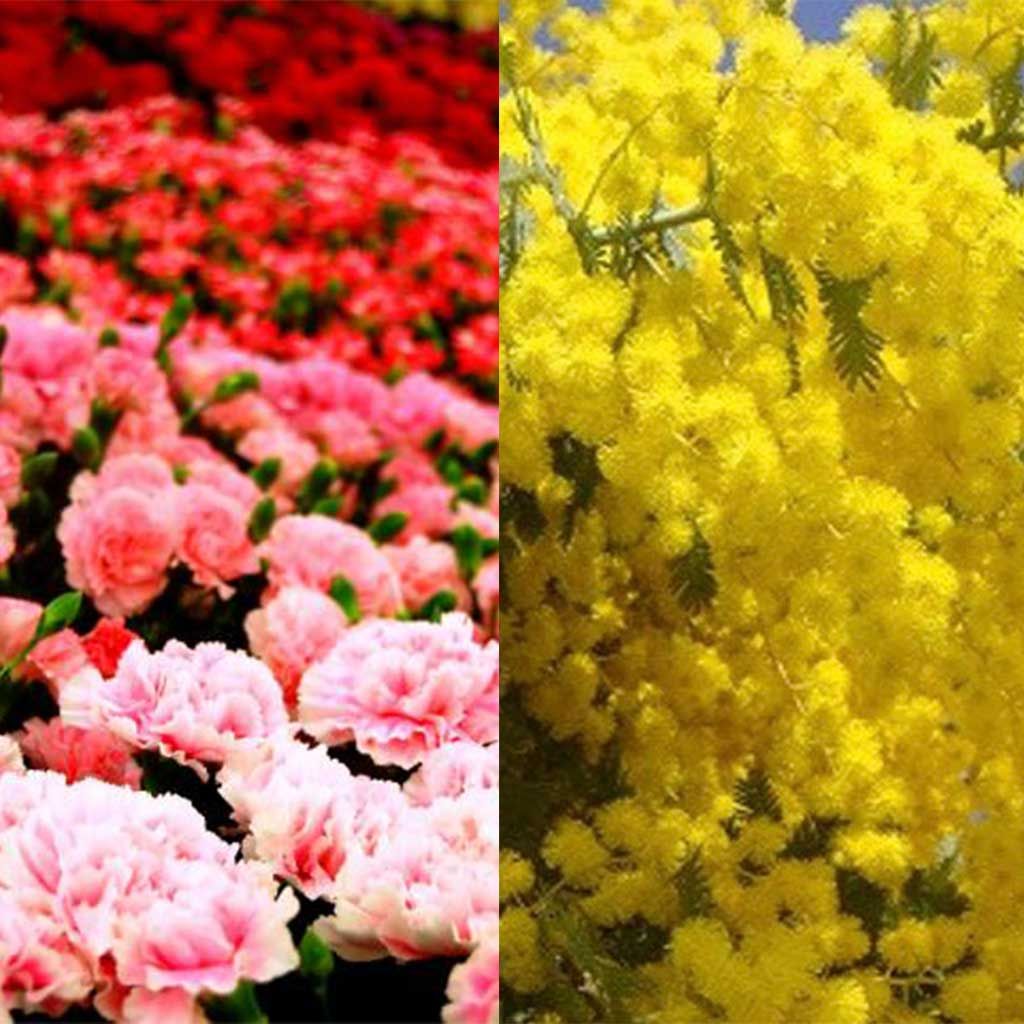
The overall flower language of Mother's Day carnations is "pure and deep love" or "affection," and it varies by color. Red means "love for mother" or "pure love," pink is "gratitude" or "warm heart," and white signifies "pure love," "respect," or "remembering a late mother."
The language of International Women's Day mimosas includes "elegance," "friendship," "gratitude," and "compassion."
The History of Mother's Day in Japan
It's said that Mother's Day was introduced to Japan from the late Meiji to the Taisho era. Initially led by Christian groups, it was banned during the war as a "Western custom."
After the war, around 1949, it became widespread again. Today, it's established as an important day to gather around the table as a family and express daily gratitude. The "love for mother" symbolized by the red carnation continues to be deeply rooted in our hearts, transcending time and borders.