Young People's Choice to 'Not Drink': How the Shift Away from Alcohol is Changing Socializing
The shift away from alcohol among youth is accelerating. We explore the rise of 'sober curious' lifestyles and how socializing is changing to focus on experiences rather than getting drunk.
As someone who loves alcohol to the point of risking liver damage, I might not fully understand, but the "shift away from alcohol" among young people seems to be accelerating. Is the culture of "nomi-nication" (drinking communication), once considered an essential skill for working adults, becoming a thing of the past? I investigated the transformation of drinking culture in modern Japan from various angles using statistical data from the National Tax Agency and the Ministry of Health, Labour and Welfare, as well as changes in leisure scenes.
The Severity of the 'Shift Away from Alcohol' in Numbers
Japan's alcohol consumption has been steadily declining since peaking in the 1990s. According to the National Tax Agency, annual alcohol consumption per adult dropped from 101.8 liters in FY1992 to 75.4 liters in FY2022. That's a loss of about one-quarter of consumption over 30 years.
The change among the younger demographic is particularly dramatic. According to the Ministry of Health, Labour and Welfare's "National Health and Nutrition Survey," the percentage of men in their 20s with a habitual drinking habit (3 or more days a week, 1 go or more per day) exceeded 20% in 1999 but has plummeted to the single digits in recent surveys. Alcohol is no longer a "daily habit" for young people. The table below summarizes key statistics from recent years.
Item | 1990s (Peak) | 2020s (Recent) |
Annual consumption per adult | 101.8L (FY1992) | 75.4L (FY2022) |
Habitual drinking rate, men in 20s | Over 20% (1999) | Single digits (%) |
Sober Curious: The Luxury of Choosing Not to Drink
Behind these statistics is not simply a "dislike of alcohol." The "Sober Curious" lifestyle, which spread from the West, is taking root among young Japanese. This is the idea that "people who can drink actively choose not to drink for the sake of their health or self-improvement."
With the spread of SNS, the value of keeping one's life and physical condition under control is rising. The value of "time performance" (taipa)—"not wanting to ruin my condition the next day" or "not wanting to waste my time"—is prioritized over the temporary euphoria caused by alcohol.
The End of Nomi-nication and 'Selective Drinking'
In the past, "nomi-nication" was considered the shortest route to internal coordination and building trust. However, this concept has drastically changed in modern workplaces. The shift to online communication post-COVID has accelerated this, and the old "mandatory for everyone" drinking parties have sharply decreased.
What today's youth prefer is not sucking up to the boss or formal toasts, but "selective drinking," where they enjoy what they like only with close friends or peers who share common hobbies. Companies, too, recognizing the risk that forced invitations can lead to harassment, are shifting to non-alcohol socializing formats like 1-on-1 meetings and lunch gatherings.
Changes in BBQ and Leisure Scenes
Major changes are also occurring in leisure scenes like BBQs, which are practically synonymous with drinking. Alcohol, which used to be bought by the case with a "beer for now" attitude, is now being replaced by a wide variety of non-alcoholic beverages.
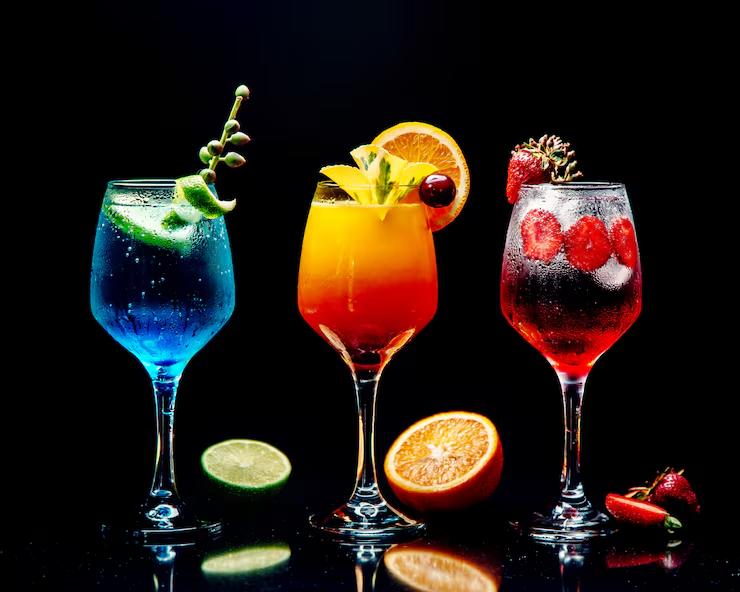
The improvement in the quality of "mocktails" (non-alcoholic cocktails) and "low-alcohol" beverages (like 0.5% ABV) that manufacturers are focusing on is remarkable, creating an environment where you can fully enjoy the atmosphere (chill time) without drinking beer. Rather than getting blackout drunk, the modern leisure style places importance on enjoying beautiful scenery and food, and sharing those moments on SNS.
The Impact of the Ministry of Health, Labour and Welfare's Guidelines
In February 2024, the Ministry of Health, Labour and Welfare published the first "Guidelines for Health-Conscious Drinking." The specific indication of health risks based on pure alcohol amount had a decisive impact on consumer consciousness. With the daily intake guideline (the boundary for increased risk of lifestyle-related diseases) set at 40g for men and 20g for women, those who used to drink "just because" began to consciously monitor their alcohol intake in numbers.
In particular, the movement to avoid high-alcohol "Strong" series beverages, which were popular for getting drunk cheaply and quickly, is accelerating. There is a growing movement to redefine alcohol not as a "tool to get drunk," but as a "luxury item" to enjoy paired with food, or as a "reward" only for special occasions.
In Conclusion: The Transforming Japanese Drinking Culture
The shift away from alcohol is by no means a decline in Japanese culture. Rather, it can be said to be an evolution into an era of "Smart Drinking" (Sumadori), where individuals value their own health and time, and respect diverse values. A new form of socializing where drinkers and non-drinkers can enjoy themselves equally at the same table is becoming a common sight at BBQs, workplaces, and homes. Yes, the liver is important.
Sources:
National Tax Agency "Sake no Shiori (2024 Edition)"
MHLW "Guidelines for Health-Conscious Drinking"
JTB Tourism Research & Consulting Co. "Trend Survey on Alcohol Consumption"